
Watercolour for Beginners: Session One
Welcome to the first session of your new hobby, it is lovely to have you here and it’s an honour to be the tutor that gets to introduce you to this wonderful pastime.
I hope that you enjoy our time together and that you have fun escaping into the world of art, don’t be hard on yourself with your creations in the weeks to come, these skills are not quick to develop and you will definitely get out what you put in.
Therefore practice as much as you can, be observant of the world around you and very soon you will be confidently creating your own masterpieces.
What you will learn this session:
Drawing Equipment - what to choose and why
How to make a variety of marks
Shading
Erasing
Sharpening pencils
Observational Drawing
Measured Drawing
The equipment you will need:
(Please note that this was filmed in 2021 and I have possibly altered the equipment I now use due to manufacture and availability. My online shop on this website has the most up to date versions of what I now recommend)
A Drawing Board, approximately A3 size
Something to tip up your drawing board so it sits on a slight slope
A4 Cartridge Paper, around 200gsm
Sketching pencils, Ali uses B and 2B grades during the demonstration
Plastic Eraser
Putty Eraser
Pencil Sharpener
or a craft knife if you prefer
A feather
The tutorial:
Timings within the video when Ali discusses particular aspects of the exercises:
01:13 - Introduction to materials
13:38 - My drawing board
16:33 - Playing with equipment
18:00 - Holding a pencil
22:33 - Turning your paper
24:28 - Shading
27:41 - Erasing
31:20 - Sharpening
34:08 - Observation
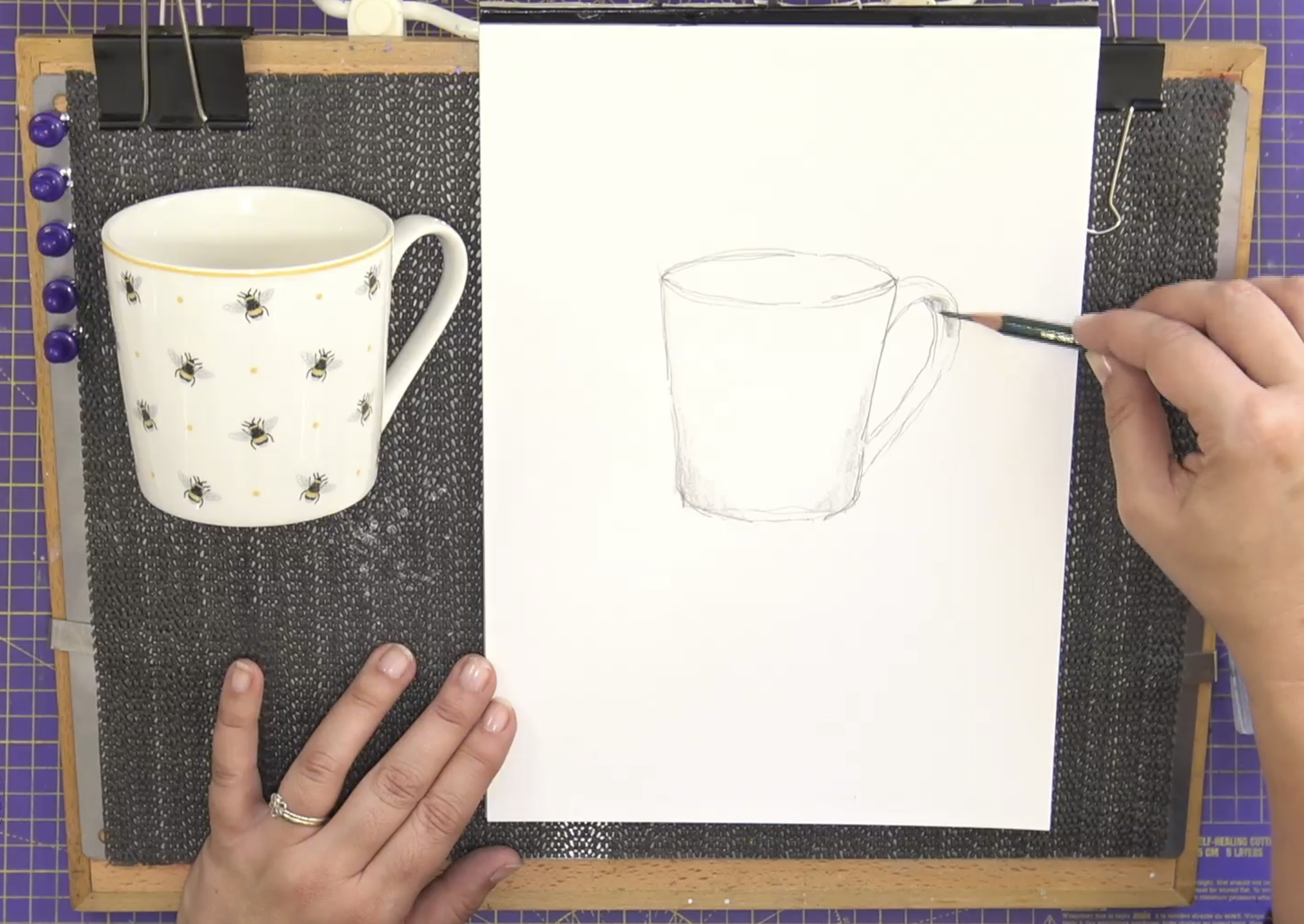
35:47 - Drawing a mug
43:35 - Measured Drawing
58:20 - Re-cap
Glossary of Terms:
(Taken from the Collins Dictionary of Art Terms and Techniques)
LINE: (Linear) Relating to the dominance of line rather than mass as a means of defining form in painting, sculpture and architecture.
Ali’s definition: Thinking about the contour of an object rather than concentrating on the shadows or textureSHADING: The filling in of areas of a picture by means of which shadows, three-dimensional form and the absence of full illumination are depicted.
Ali’s definition: Using a tone to give an object body and to fool the eye into thinking that a flat piece of paper can describe a three-dimensional object.MARK MAKING: No entry in CDATT
Ali’s definition: A variation of strokes or applications to the surface that gives the object a quality that defines its structure or texture.OBSERVATIONAL DRAWING: No entry in CDATT
Ali’s definition: Using your eyes alone to asses how an object is constructed in order to effectively draw or paint itMEASURED DRAWING: No entry in CDATT
Ali’s definition: Using a constant, usually an outstretched arm, to prove how lines and shapes are relateable to each other, thereby proving or disproving work created by Observational Drawing
CROSS HATCHING: Shading with fine, closely set parallel lines. When a second series of lines crisscrosses the first set, the variety of size and closeness can indicate light and shadow.
Ali’s definition: I can’t put it better than that!
Homework:
By no means compulsory, homework is only suggested to allow each participant the opportunity to expand on what they have learnt in this session:
Keep repeating everything we experimented with, including making sure that your materials are doing what they should. Bear in mind that if you have poor materials this is going to affect the outcome of your drawing and while I understand that everyone has a budget, it may be that your results are being held back by inferior tools.
Try another object from around your house but keep it simple. Don’t leap into cutting a cabbage in half and attempting to replicate the texture inside, maybe look at simple shaped objects or fruit and veg. I’d recommend a variety of cups (avoid glass), a red pepper, an apple, a banana or a plain vase without flowers.