
Watercolour for Beginners: Session Two
You made it to week two - congratulations!
I’m hoping that you are starting to see the world a little differently and the idea of recording what you see in your own unique way is becoming a reality.
Artists are constantly looking for their ‘style’ - the thing that makes them different from the others and the good news is that you will already have it within you and it’s up to me to encourage it out of you. Therefore, this week is all about developing those drawing skills further and helping you to progress.
What you will learn this session:
Adding to your drawing tools
Further blending techniques
Erasing with precision
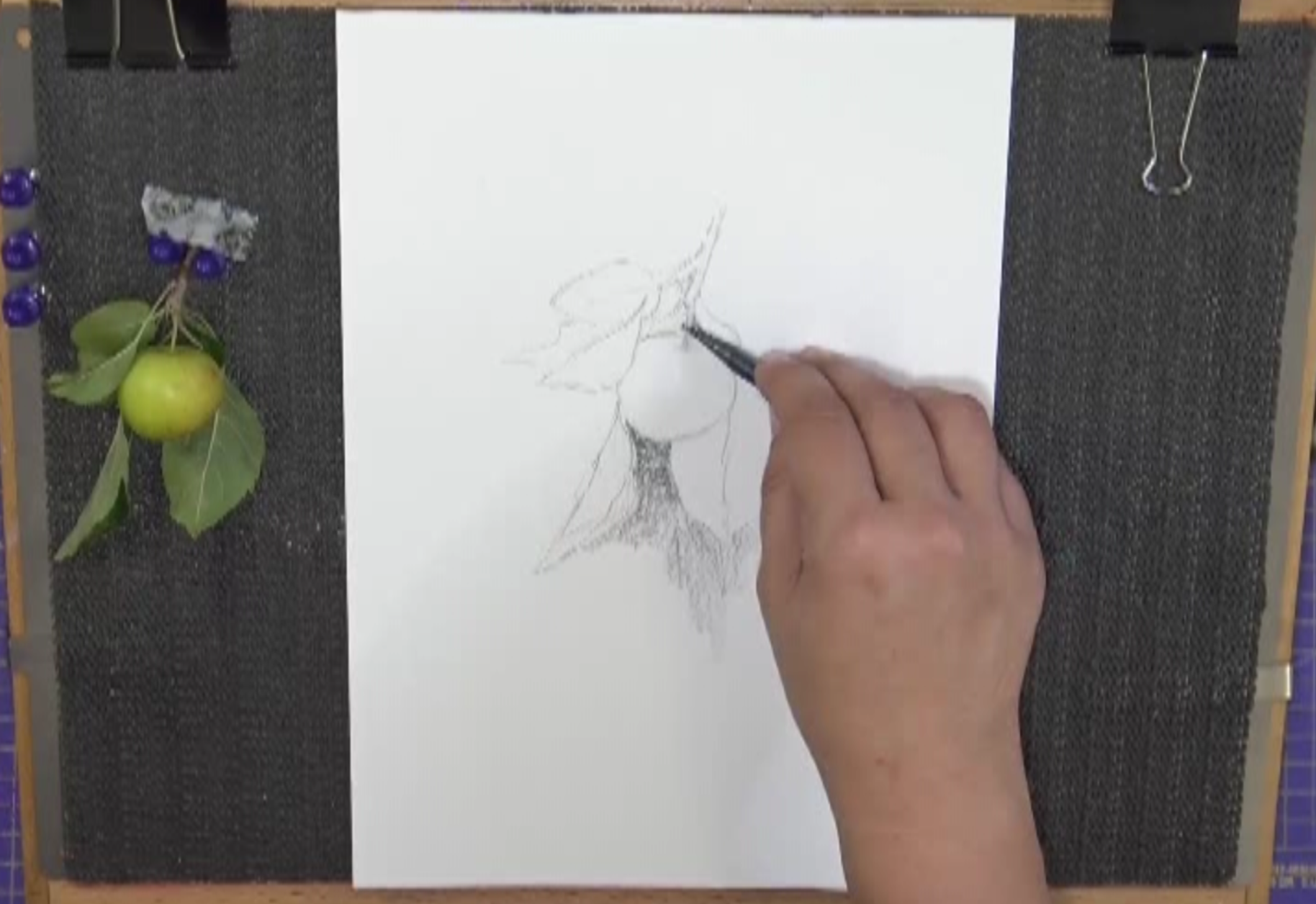
Drawing from nature
Styles of drawing
Creating a three dimensional effect
The equipment you will need in addition to last week:
(Please note that this was filmed in 2021 and I have possibly altered the equipment I now use due to manufacture and availability. My online shop on this website has the most up to date versions of what I now recommend)
A graphite stick
‘Mono’ eraser
Battery eraser
Paper Stump
Sandpaper
The tutorial:
Timings within the video when Ali discusses particular aspects of the exercises:
0:53 - Re-cap on the first session
1:51 - New materials
12:37 - Texture with a Graphite Stick
15:12 - Bringing the outside indoors
19:57 - Line drawing with pencil
25:34 - Refining the drawing
30:53 - Considering styles of drawing
35:45 - What to leave out
36:56 - Background shading/Negative space
43:15 - Blending
47:14 - Adding detail
52:37 - Adding shadow and texture
Glossary of Terms:
(Taken from the Collins Dictionary of Art Terms and Techniques)
TEXTURE: In a work of art, the artist determines, by choice of technique and method of using it.
Ali’s definition: Art dictionaries tend to focus on texture in relation to the surface being drawn on but in this lesson, it relates to how we make an object look textured by how we apply graphite.IMPRESSIONISTIC: The first modern art movement, breaking away from clearly defined objects and concentrating on the notions of light and colour.
Ali’s definition: ‘Essence of’ rather than counting every last spot, dimple or nuance of an object. Creating an idea of a subject instead of a slavish representation.DETAIL: No entry in CDATT.
Ali’s definition: Focusing on an element of a subject that brings together all of the aspects and concentrates on getting the definition as accurate as possible.BOTANICAL: No entry in CDATT.
Ali’s definition: Where are entire painting illustrates every single aspect of a subject including nuances of colour, detail, texture etc. in almost photographic representation.
Homework:
By no means compulsory, homework is only suggested to allow each participant the opportunity to expand on what they have learnt in this session:
Keep repeating everything we experimented with, including making sure that your materials are doing what they should. Bear in mind that if you have poor materials this is going to affect the outcome of your drawing and while I understand that everyone has a budget, it may be that your results are being held back by inferior tools.
Try another object from nature but keep it simple. Maybe choose different leaves or a single plant rather than an entire tree? You could even experiment with painting them in situ instead of bringing them indoors. Make sure to date what you have drawn to see how far you have come.
With that in mind, compare the drawings you did from our last session with these and you should see that in a short time you have progressed and developed your drawing skills.