
Watercolour for Beginners: Session Five
You have been doing brilliantly and I hope you are thrilled with your achievements so far? Don’t be too tough on yourself if you’re not quite where you would like to be, this isn’t a quick skill to learn and it will provide you with the best appreciation of art as you will understand what it takes to put a painting together.
With that in mind, let’s start as we mean to go on and try a simple composition together - a few trees…
What you will learn this session:
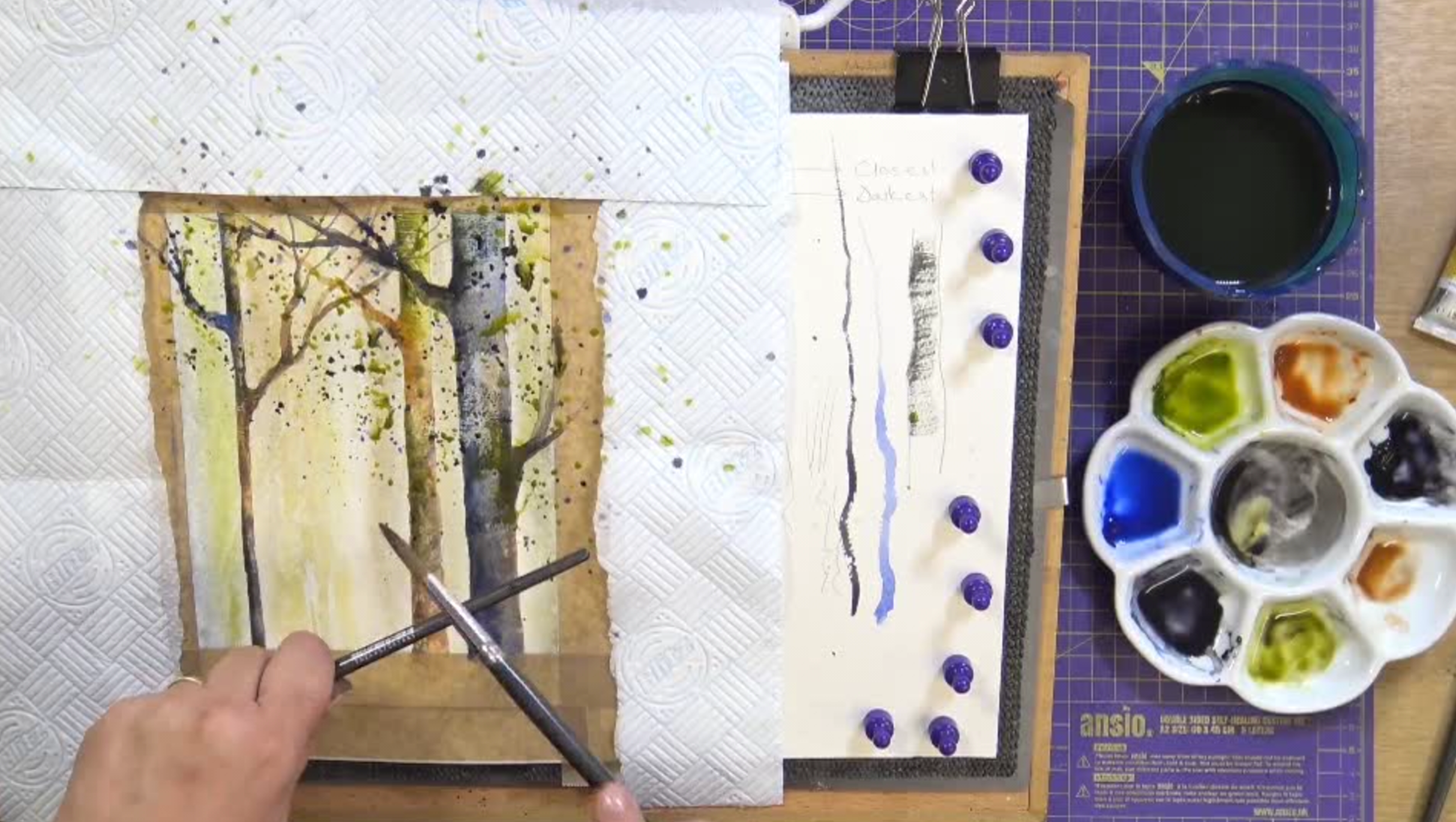
Preparing your painting area
Wet into wet ghost trees
Rag Rolling
Letting colours blend together
How to use a Rigger
Tree branches
Adding depth and shadows
Using a Flat brush
Adding texture for bark
Kitchen Roll masking
Spattering for foliage
The equipment you will need in addition to previous sessions:
(Please note that this was filmed in 2021 and I have possibly altered the equipment I now use due to manufacture and availability. My online shop on this website has the most up to date versions of what I now recommend)
A Rigger brush, approximately Size 2
A Flat brush, approximately 12mm
A Size 10 Imitation Sable
Framer’s Tape
The tutorial:
Timings within the video when Ali discusses particular aspects of the exercises:
5:18 - Constructing a ‘box’
7:30 - Masked edges
10:46 - Drawing trunks
12:10 - A watercolour principle
13:58 - Preparing the colours
15:25 - Wet into wet background
18:15 - Rag rolled background
19:20 - Faffing
20:34 - Drying
23:21 - The paper dance
24:20 - Wet-into-damp
28:10 - Blocking in the trunks
33:33 - Using a rigger
43:57 - Drybrush with a flat
47:36 - Adding shadow
50:36 - Kitchen roll mask
51:22 - Spattered Foliage
53:20 - The reveal
Glossary of Terms:
(Taken from the Collins Dictionary of Art Terms and Techniques)
RIGGER: Originally a lettering brush, named as it was used when sailing vessels with their rigging accurately depicted
DRYBRUSH TECHNIQUE: The technique of creating a broken or mottled effect, revealing traces of the paper.
Homework:
By no means compulsory, homework is only suggested to allow each participant the opportunity to expand on what they have learnt in this session:
Repeat this exercise as often as you like and make it your own by changing the colours or altering the composition. Make mistakes, write notes, photograph what you have done so you can compare it on a device - whatever it takes for you to understand how the paints, brushes and paper react with each other.
Ahead of our next session together, find out a camera or understand your smartphone better in order to start collecting your own reference materials to paint from.